


Certifications to Check When Buying Numb Creams
- Understanding topical anesthetics and how they are regulated
- Mechanism and common active ingredients
- Regulatory context: drugs vs cosmetics
- Why classification affects certification expectations
- Key certifications and documents to verify
- Certificate of Analysis (COA) and lab testing
- Good Manufacturing Practices (GMP) and ISO standards
- MSDS / SDS and ingredient disclosure
- How to interpret labels, claims, and independent marks
- Common marks and what they mean
- Reading the ingredient panel and concentration
- Expiration, lot number and batch traceability
- Practical verification steps and supplier questions
- Checklist I use before purchasing
- Questions to ask suppliers
- When to involve a clinician or pharmacist
- Comparing certifications and documents (quick reference)
- Brand and supplier considerations — practical example: QM Makeup
- Why supplier background matters
- About QM Makeup and how they align with purchasing checks
- Products and competitive strengths
- Safety practices for studio use
- Patch tests and client screening
- Application limits and record-keeping
- Handling adverse events
- FAQs
- 1. Is FDA-approved the same as safe for tattoo use?
- 2. What is a COA and why do I need it?
- 3. Can a numb cream be marketed as a cosmetic?
- 4. How should I store numb creams in the studio?
- 5. What if a supplier cannot provide a COA or GMP evidence?
- 6. Are natural or herbal numbing creams safer?
- Closing and contact
When you search for a numb cream before tattoo application, you want more than marketing claims — you need verifiable safety and consistent performance. In this article I summarize which certifications and documents truly matter, how to read them, and what checks I perform when evaluating creams for semi-permanent makeup (PMU) and eyelash tattoo procedures. I combine regulatory references, lab testing standards, and practical supplier-audit steps so you can make an informed purchase decision that minimizes client risk and legal exposure.
Understanding topical anesthetics and how they are regulated
Mechanism and common active ingredients
I always start by checking the active ingredient. For numb cream before tattoo use, common local anesthetics include lidocaine, prilocaine, tetracaine, and benzocaine. These agents act by blocking sodium channels in peripheral nerves to reduce pain sensation (see Local anesthetic - Wikipedia). Concentrations matter: higher percentages increase numbing efficacy but also risk systemic absorption and toxicity.
Regulatory context: drugs vs cosmetics
It’s crucial to know whether a product is marketed as a drug (topical anesthetic) or a cosmetic. In the U.S., many topical anesthetics fall under OTC drug monographs and are regulated by the U.S. Food & Drug Administration (FDA). In the EU, topical anesthetics used for pain relief may be regulated under medicinal product rules or, if formulated and marketed differently, under cosmetic regulation (European Commission - Cosmetics). Understanding this classification helps determine what approvals or notifications to expect.
Why classification affects certification expectations
If a cream is a drug, look for compliance with relevant drug regulations and labeling; if it’s a cosmetic product marketed for mild pain relief, expect compliance with cosmetic safety assessments and ingredients restrictions (EU Regulation (EC) No 1223/2009). Mislabeling can indicate regulatory risk and possible enforcement action — I avoid suppliers who give vague answers about regulatory status.
Key certifications and documents to verify
Certificate of Analysis (COA) and lab testing
A current COA from an accredited laboratory is non-negotiable. The COA should list active ingredient concentrations, microbial test results (e.g., total aerobic microbial count, absence of pathogens like Staphylococcus aureus), heavy metals, and preservative efficacy. Prefer labs accredited to ISO/IEC 17025, which verifies testing competence. If a supplier can’t provide a COA or the COA is unsigned/outdated, treat the product as high risk.
Good Manufacturing Practices (GMP) and ISO standards
For creams, look for compliance with cosmetic GMP such as ISO 22716 or equivalent national GMP. These demonstrate controls over production, traceability, and quality. If a product is framed as a medical device or drug-delivery adjunct, relevant standards may include ISO 13485 (medical device QMS). I always request documentation showing the manufacturer’s quality system and factory audit records.
MSDS / SDS and ingredient disclosure
The Material Safety Data Sheet (MSDS) or Safety Data Sheet (SDS) provides hazard, storage, and first-aid information. SDS must be consistent with the ingredient list and concentrations. For client safety I verify that SDS warnings, maximum recommended application area, and systemic toxicity guidance are clearly stated.
How to interpret labels, claims, and independent marks
Common marks and what they mean
Claims like FDA-approved are often misused. The FDA does not approve cosmetics; for topical anesthetics it may regulate active drug ingredients under OTC monographs. European CE marking relates to medical devices, not creams, unless the product is legitimately a device. Don’t rely on a single mark; require supporting documentation. For lab tests, prefer third-party results over in-house tests.
Reading the ingredient panel and concentration
Read both INCI names and common names (e.g., lidocaine). For procedures such as semi-permanent makeup I check maximum recommended concentration and cumulative dosage, especially when treating multiple areas or performing extended sessions. For example, lidocaine systemic toxicity is dose-dependent; guidelines vary, so check recommendations from professional bodies and product SDS entries.
Expiration, lot number and batch traceability
A valid lot number, manufacture date, and expiration ensure you can trace adverse events and recall batches if needed. I will not accept creams with missing or tampered lot codes. Traceability is a key GMP principle and required by regulatory frameworks such as ISO 22716 and drug regulations.
Practical verification steps and supplier questions
Checklist I use before purchasing
My practical checklist for vetting a numb cream before tattoo work includes:
- Obtain the COA from an accredited lab (ISO/IEC 17025).
- Confirm GMP evidence (ISO 22716 or equivalent).
- Review SDS, ingredient list, and concentration.
- Check regulatory status: OTC drug monograph, cosmetic notification, or medical device classification.
- Verify batch lot numbers and shelf-life testing/stability data.
- Request preservative and microbial challenge test results.
Questions to ask suppliers
When I contact a supplier, I ask: Can you provide a recent COA for this exact batch? Is your lab ISO/IEC 17025 accredited? Which GMP standard do you follow? Where is the product manufactured and can you provide a factory audit? Clear, verifiable answers separate professional manufacturers from resellers or private-labelers who may lack quality control.
When to involve a clinician or pharmacist
If the cream contains higher concentrations of anesthetic or is used on sensitive areas (eyelids, mucosa), I consult with a medical professional to confirm dosing safety and potential contraindications. For semi-permanent makeup around the eyes, interaction with ocular surface or systemic absorption can be significant; a clinician’s input is prudent.
Comparing certifications and documents (quick reference)
| Document/Certification | Scope | What it proves | Relevance for numb creams |
|---|---|---|---|
| COA (Certificate of Analysis) | Batch-specific lab results | Active content, microbial, heavy metals, stability | Essential — verifies safety and correct concentration |
| ISO/IEC 17025 (Lab accreditation) | Lab testing competence | Reliability of test methods and results | High — prefer COAs from accredited labs |
| ISO 22716 / Cosmetic GMP | Manufacturing quality for cosmetics | Production controls, traceability, hygiene | Important for cosmetic-classified creams |
| FDA (OTC Monograph) | U.S. regulatory framework for OTC drugs | Compliance with labeling and allowed actives | Critical if product is marketed as anesthetic in U.S. |
| CE Mark (medical device) | Medical device conformity in EU | Safety and performance for devices | Only relevant if product legitimately classified as device |
| SDS / MSDS | Safety and hazard information | Storage, first aid, exposure limits | Useful for handling and emergency protocols |
Sources: FDA topical anesthetic overview (FDA), ISO standards (ISO 22716, ISO/IEC 17025) and general local anesthetic mechanisms (Wikipedia).
Brand and supplier considerations — practical example: QM Makeup
Why supplier background matters
From my experience sourcing supplies for PMU studios, a supplier’s track record, production scale, and R&D capability matter as much as individual documents. A producer with integrated R&D and manufacturing is more likely to provide consistent batches, timely COAs, and custom formulation support when needed.
About QM Makeup and how they align with purchasing checks
QM Makeup was established in 2005; we specialized in the field of semi-permanent makeup and eyelash tattoo beauty, and we are committed to becoming a leading company in the industry. We specialize in permanent makeup and eyelash beauty products, providing professional wireless tattoo machines, microblading machines, semi-permanent makeup ink, tattoo skin for practice, tattoo numb cream, a professional lash lift kit, the best lash lift and tint kit, professional eyelash glue and eyelash extension lashes products.
Our company integrates distribution, wholesale, private labeling and OEM processing on a large scale. We provide customers with a full range of customized branding solutions to help our partners maximize business value. Our production base covers an area of 10,000 square meters and has independent research and development and production capabilities, helping customers achieve product customization and providing one-stop tattoo supplies brand solutions.
When I evaluate QM Makeup (or any supplier), I verify COAs for batches, request evidence of manufacturing controls (GMP), and confirm that lab tests come from accredited labs. QM Makeup offers these documents on request and provides product customization, which can include formulation adjustments and private-label solutions — useful for salons seeking unique branding while maintaining regulatory compliance.
Website: https://www.qmmakeup.com. Contact: [email protected].
Products and competitive strengths
QM Makeup’s core products include tattoo machines, tattoo ink, microblading supplies, tattoo supplies, and false eyelashes. Their competitive advantages I value are: integrated R&D and production (reduces supply-chain opacity), private-label/OEM capacity (helps studios scale their own brands), and a large production base enabling batch testing and traceability. If you consider bulk purchase or private labeling, request COAs, factory audits, and product stability data up front.
Safety practices for studio use
Patch tests and client screening
Even with verified certifications, perform a patch test 24–48 hours before treatment for first-time users or when changing brands. Screen clients for allergies to local anesthetics (e.g., history of adverse reactions), pregnancy, or medications that increase systemic absorption risk. Document results and client consent.
Application limits and record-keeping
Follow manufacturer-recommended application area, maximum total dose, and contact time. Keep treatment records with product name, batch/lot number, amount applied, and any observed reactions. These records are essential if an adverse event occurs and for internal quality audits.
Handling adverse events
Have a protocol for signs of local anesthetic systemic toxicity (LAST) and allergic reactions, and ensure staff are trained in emergency first aid. Maintain SDSs on file and ensure waste disposal complies with local regulations.
FAQs
1. Is FDA-approved the same as safe for tattoo use?
Not necessarily. The FDA regulates topical anesthetic active ingredients under OTC monographs. FDA-approved is often misused. Verify whether the product is regulated as an OTC drug and review labeling and COAs. See the FDA overview: FDA topical local anesthetics.
2. What is a COA and why do I need it?
A COA (Certificate of Analysis) is a batch-specific report showing measured levels of active ingredients, preservative efficacy, microbial counts and other quality tests. It proves the batch meets specifications and should come from an accredited lab (ISO/IEC 17025).
3. Can a numb cream be marketed as a cosmetic?
Some products marketed for numbing may be positioned as cosmetics with very limited pain-relief claims. Regulatory classification is jurisdiction-dependent. If the product makes medical claims or contains higher concentrations of anesthetic, it may be regulated as a drug or medical device. Check local regulation (EU cosmetics).
4. How should I store numb creams in the studio?
Follow the product SDS: typically store in a cool, dry place away from direct sunlight, and record opening dates. Respect shelf-life and discard after recommended period post-opening (e.g., PAO — period after opening). Keep lot numbers for traceability.
5. What if a supplier cannot provide a COA or GMP evidence?
Proceeding without those documents increases risk. I recommend refusing to purchase until the supplier can provide verifiable, current COAs and evidence of manufacturing controls. For private-label arrangements, make COA and audit evidence contractually mandatory.
6. Are natural or herbal numbing creams safer?
Natural does not automatically mean safer. Plant-based ingredients can still cause allergy or interact with anesthetic agents. The same verification (COA, microbial testing, stability) applies regardless of marketing claims.
Closing and contact
Choosing a reliable numb cream before tattoo procedures requires checking certifications, reading COAs and SDS, verifying lab accreditation, and ensuring production traceability. My practical checklist (COA, ISO/IEC 17025 labs, GMP evidence, lot traceability, and clinician consultation for high-risk cases) has helped studios reduce incidents and improve client trust.
If you’d like supplier-verified products or private-label solutions, QM Makeup offers a broad range of PMU and eyelash products and can provide batch COAs and manufacturing documentation on request. Visit QM Makeup or contact [email protected] to discuss product options, OEM/private labeling, or to request technical documentation.
Products QM Makeup specializes in: tattoo machine, tattoo ink, microblading tools, tattoo supplies, and false eyelashes. Our strengths: integrated R&D and production, a 10,000 m2 production base, wholesale and OEM/private-label services, and comprehensive testing and documentation support.
Before your next purchase of numb cream, ask for the COA, lab accreditation, GMP proof, SDS, and lot traceability — and always perform a patch test. If you need help auditing suppliers or interpreting lab reports, I’m available to consult and review documentation to protect your clients and your practice.
Contact / Request documentation: https://www.qmmakeup.com | [email protected]
Custom Microshading Tools Manufacturers and Suppliers Turkey
What is eyelash lifting
What is tattoo needle
Top 5 microblading pigment Company List and Products Compared
Eyelash curling
Can customers with sensitive skin or eyes use lash perm kit?
For customers with sensitive skin or eyes, it is recommended that a patch test be performed prior to use lash lift perm kit. However, our formula is relatively mild and anti-allergenic, so it is normally non-allergenic and suitable for most people.
Handmade pen
What size of microblading pen should I choose?
Currently, the more popular thicknesses are 0.16mm and 0.18mm; the popular sizes are 16U, 18U, and 18P. How to choose a microblading brow tools that suits you can refer to the advice on choosing a best microblading blade to use, which depends largely on several factors, including the type of eyebrow tattoo, the degree of detail required, and personal tattooing skills. Here are some basic guidelines:
Type of eyebrow tattoo: Detail and line tattoo: Finer lines and details can usually be achieved with finer needles (such as 0.16mm or 0.18mm).
Filling and shading: Slightly thicker needles (such as 0.20mm or 0.25mm) may be required to achieve better color coverage and shading effects on the skin.
Personal tattooing technique: Novice tattoo artists may tend to use thicker needles to minimize the operation time on the skin, while experienced tattoo artists have the flexibility to choose needles of different thicknesses to achieve more diverse effects.
Skin type: The texture and thickness of different skin will also affect the choice of needles. Thicker skin may require slightly thicker needles to ensure color and lines penetrate effectively.
Hair Condition: The thickness of your client’s natural hair is also an important factor in choosing needle thickness. Thicker hair requires slightly thicker needles to ensure lines are consistent with the natural hair.
Super Essence
How should I choose a numbing product? Order of use and recommendations?
Generally speaking, we recommend choosing numbing products based on your operating experience, usage habits, treatment stage, treatment area, and applicable population. Here are some tips for choosing numbing products.
1. Treatment stage: Before treatment: tattoo numb cream/tattoo numb essence; During treatment: secondary tattoo numb essence
2. Treatment area: Eyebrows: tattoo numb cream/tattoo numb essence/eyebrow patch; Eyeliner: numbing cream; Lips: tattoo numb cream/numbing essence/lip patch; Body: tattoo numb cream.
3. Operating experience: Beginner: tattoo numb cream; Professional: all are okay
4. Applicable skin: Normal skin: all are okay; Sensitive skin: nano numb cream
Super numb
Can tattoo numb cream be used on the lips?
Yes, super numb tattoo cream can be used on the lips.
Tattoo Numbing Patches
How many percentage of the numbing can be reach?
Our mature and stable numbing formulas typically achieve more than 90% numbing effects. It can keep numbing effect last for 3-4 hours.

Professional Pre Inked Eye Brow Mapping String 30m
Microblading Pre-inked Mapping String Line 10m
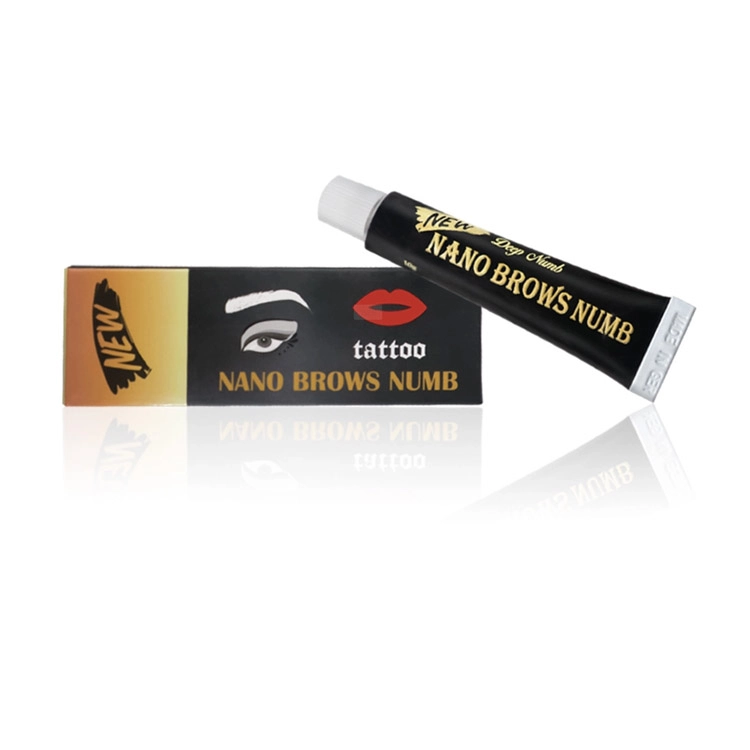
Nano Brows Numb Cream For Tattoo

Instagram
Facebook
YouTube